

Heat Exchanger Tubes & U Tubes
ASR MET Tech manufactures seamless heat exchanger tubes and U-tubes in India for shell-and-tube equipment used across industrial plants. For critical-service orders, every tube undergoes 100% eddy current and ultrasonic testing, so hidden defects are found before dispatch.
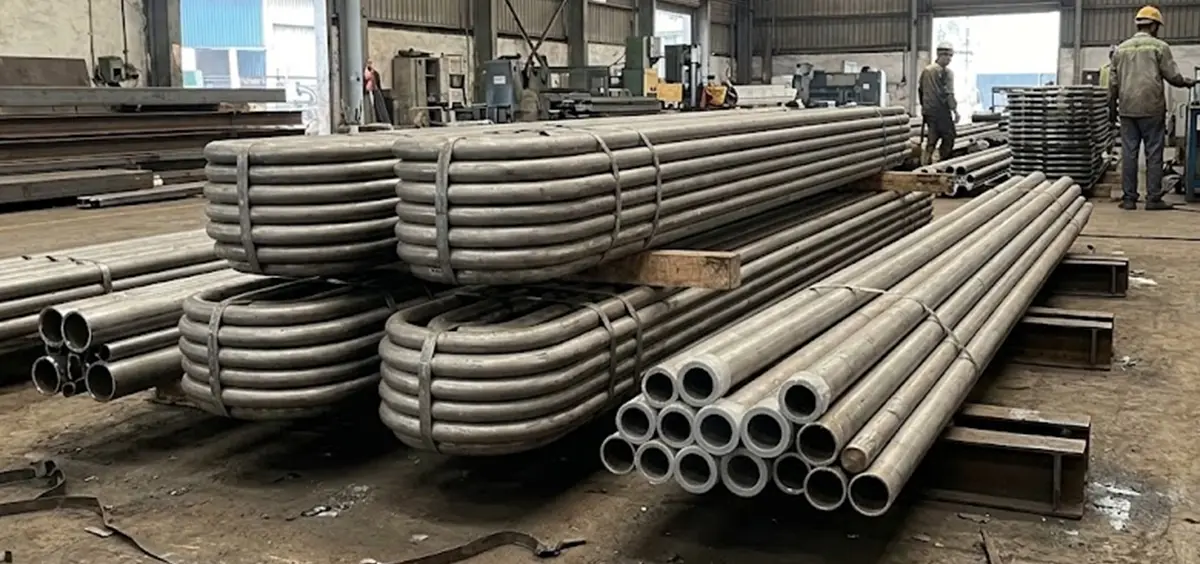
ASR MET Tech, a leading manufacturer of heat exchanger tubes in India, provides high-quality, seamless metal tubes that are available in various diameters, wall thicknesses, and lengths, either straight or bent into a U-shape, built specifically for heat-transfer equipment that is used in industrial plants.
100% ECT & UT on Critical Services
ASTM A213, A249, A688; TEMA
Straight Up to 25 M & U-Bends
Heat Exchanger Tubes In a Glimpse
A shell (large cylindrical container) contains many thin tubes that run inside; these tubes are known as heat exchanger tubes. One fluid flows inside these tubes while another fluid flows around the tubes. These two fluids never touch or mix directly. Heat passes from the hotter fluid to the cooler fluid through the thin metal wall of the tube. This setup is known as a “shell-and-tube exchanger”; one fluid gets heated or cooled by the other. As a leading supplier of heat exchanger tubes and pipes in India, we follow certain practices to ensure quality. For instance, regular pipes are usually measured by pipe schedule; heat exchanger tubes use a different sizing system. These tubes are either seamless or welded; that’s why the process needs to be extremely precise.
We manufacture these tubes by the seamless method, and the range we offer includes exchanger tubes from OD 9.53 mm to 50.88 mm, walls 0.5 mm to 3.68 mm, in lengths up to 25 m, straight or formed into U-bends. Tubes are made to ASTM A213/ ASME SA213 and related specifications. We make the tubes by following ASTM A213/ ASME SA213 technical standards, recognised in the United States.
What does a Heat Exchanger Tube Do?
The role of a heat exchanger tube is demanding; it must transfer heat efficiently, so the tubes need to be thin so that heat can pass through them from one fluid to the other. It has to hold pressure on both sides, at different levels. As stated earlier, one fluid flows inside the tube while another flows around it. The tube needs to be strong enough to handle high pressure without bursting, bending, or collapsing. The tubes we make are tough and corrosion-and-damage-resistant. The fluid that flows inside the tube and the outside fluid are different substances, and they could be corrosive if the tubes are not strong enough. We ensure that the tube seals properly into the tube sheet, with reliable consistency. The consistent sizes matter because too small or too large sizing leads to leaks; that’s why we put great emphasis on making our exchanger tubes highly consistent, with a precise outer diameter throughout their length.
AST MET Tech, a top heat exchanger tube manufacturer in India, supplies seamless tubes for this duty. Seamless construction matters the most as one of the best heat exchanger tubes and pipes suppliers:
Consistent OD - ensures reliable, repeatable joints when sealing into the tube sheet, every single time.
For maximum heat transfer efficiency, it is crucial to have thin walls, starting from 0.50 mm.
To ensure maximum strength and reliability, we offer a seamless construction.
We offer 100% ECT (Eddy Current Testing) and UT (Ultrasonic Testing) performed on every single tube for key-service orders. We identify the hidden defects before making the final shipment.
Dimensional Specifications
Please send us the following details from your tube-sheet drawing: OD, wall thickness, length, quantity, leg lengths, centreline bend radii, bend schedule (if available).
| Parameter | Range / Detail | Standard reference |
|---|---|---|
| Outside diameter | 9.53 mm – 50.88 mm | ASTM A213 / EN 10216-5 |
| Wall thickness | 0.50 mm – 3.68 mm | ASTM A213 |
| Length | Up to 25 m — straight, or developed length for U-bends | Per order |
| Form | Straight tube, or U-bend to customer bend schedule | TEMA |
| OD tolerance | Per ASTM A213 by size group; tighter to order for critical tube-sheet fits | ASTM A213 |
| Wall tolerance | ±10% standard | ASTM A213 |
| Surface finish | Pickled & passivated standard; bright annealed to order; | — |
| End finish | Plain, deburred; bevelled to ASME B16.25 on request | ASME B16.25 |
| Marking | Grade, standard, heat number, size | ASTM A213 |
U-Tubes: What Actually Happens When You Bend a Tube
A U-Tube bundle is a set of tubes that are bent into a U-shape, providing two huge advantages to an exchanger. The U-tube handles thermal expansion naturally; when metal heats up, it expands slightly, and when it cools, it contracts. A straight-tube design fails because this expansion/contraction creates stress in the system that requires an extra part known as an ” expansion joint” to absorb that movement.
ASR MET Tech builds U-tubes that act like a natural flexible joint, it can stretch slightly when the temperature changes, so there is no need for a separate expansion joint. Cleaning also becomes easier as the entire bundle can be pulled out of the shell.
Every single tube in the bundle now has a bend in it, and that bend is one of the most vulnerable parts of the tube. If the bend is made carelessly, it will fail badly. Three things happen inside the metal when a straight tube gets bent into a U-shape:
The outer curve of the bend stretches and becomes thinner; the inside of the curve gets compressed. It can fail to meet the minimum thickness required by various industry standards.
The inner curve of the bend becomes compressed and can wrinkle. Small folds in the tube wall lead to failure points.
The bending process hardens the metal and creates internal stress. It also changes the shape and internal structure. For operating environments with harsh conditions, tubes become much more vulnerable, resulting in a specific type of failure known as stress corrosion cracking (SCC).
How ASR Overcome “Stress Corrosion Cracking” Failure
We heat treat the tube after it’s been bent; our heat treatment involves carefully heating the metal to a defined temperature, which reduces the risk of stress corrosion cracking later on. As a top heat exchanger tube manufacturer in India, we follow the major industry standards, TEMA RCB 2.31, and ASME Section VIII Division 1, UG-79.
Does My Bundle Need Post-Bend Heat Treatment?
ASR MET Tech helps you identify if your specific tube bundle needs post-bend heat treatment or not, bascially they decide based on three factors: grade of the tube material, bend ratio, and service
Let us know the use case of your tubes; we will assess and tell you what exactly we think is needed, and we’ll quote the project accordingly. In some cases, they assume or completely skip this process, leading to huge failures.
| At the Bend | What Happens | What to Specify |
|---|---|---|
| Wall Thinning at the Bend | The outer fibre stretches, while the starting wall is selected so the thinned wall still meets the minimum required at the bend. | Confirm the minimum wall your code requires after bending, not before. |
| Minimum Bend Radius | A centreline radius of about 1.5 × tube OD is the common industry floor; tighter radii risk wrinkling on the inner fibre. | Indicative industry norm - ask us for ASR's actual minimum radius by OD. |
| Post-Bend Heat Treatment | Required once cold forming passes the limits in TEMA RCB-2.31 / ASME VIII Div.1 UG-79. Relieves residual stress from bending. | Essential in chloride service, where residual stress drives SCC. |
| NDE of the Bend Area | Dye-penetrant inspection of the bend, plus eddy current over the full tube length. | State the acceptance standard on the order. |
| Leg Lengths & Layout | Bends are produced to the row-by-row bend schedule taken from your tube-sheet drawing. | Send the drawing - it removes a round of questions. |
Send us the following details for a U-bend enquiry: Tube OD and wall, material grade and standard, bend schedule, total tube count, whether post-bend heat treatment is required, and what NDE you want on the bend area. We will quote a firm price to you after gathering all the key details.
Choose the Grade by Service, Not By Assumption
A heat exchanger tube can fail from either side: from the fluid flowing inside it or from the fluid flowing around it on the outer side; both are equally important. So it’s very crucial to choose a high-quality material grade. It will work well for both the tube-side fluid and the shell-side fluid, not just one of them.
SS 304/304L
General Duty
A versatile stainless steel grade for general-purpose applications, SS 304 offers good corrosion resistance and weldability. The low-carbon 304L version is preferred where welding is involved.
SS 316/316L
Corrosion Resistant
With added molybdenum, SS 316 provides better resistance to chlorides and pitting than 304. SS 316L, with its lower carbon content, is well suited to welded applications.
SS 316Ti
High Temperature
Titanium-stabilised SS 316Ti offers good corrosion resistance and strength at elevated temperatures. It is suited to applications where both heat and corrosive conditions need to be handled.
SS 321H/347H
Elevated Temperature
These stabilised grades are designed for high-temperature service, helping resist carbide precipitation during prolonged exposure to heat. 321H and 347H are suitable for demanding elevated-temperature applications.
Which Specification Applies to Your Tube
| Specification | What it covers | Type |
|---|---|---|
| ASTM A213 / ASME SA213 | Seamless Ferritic and Austenitic Alloy-Steel Boiler - most of the seamless exchanger tubes are made to this standard specification. | Seamless |
| ASTM A249 / ASME SA249 | Welded Austenitic Boiler, Superheater, heat-exchanger, and Condenser Tubes - covering the same broad range of uses, including boilers, superheaters, heat exchangers, and condensers. | Welded |
| ASTM A688 / ASME SA688 | Seamless and Welded Austenitic Stainless Steel Feedwater Heater Tubes - Both seamless and welded tubes are covered by this specification, specially designed for feedwater heaters. The feedwater pre-heats the water before it enters a boiler, making the entire system more energy-efficient. | Feedwater heater |
| ASTM A269 / ASME SA269 | Seamless and Welded Austenitic Tubing for General Service - Best for general corrosion resistance; however, not suitable for handling high pressure. | General service |
| ASTM A268 / ASME SA268 | Seamless and Welded Ferritic and Martensitic Stainless Tubing for General Service- This offers different strength and magnetism, meant for general-purpose use, not for applications with high pressure. | Ferritic/martensitic |
| EN 10216-5 TC1 / TC2 | European Seamless Steel Tubes for Pressure Purposes - As per the European equivalent standard for seamless stainless steel tubes meant for pressure applications. | European |
| TEMA | TEMA is an industry association that sets widely-used technical standards specifically for the design, construction, and performance of heat exchangers. | Exchanger |
| EN 10204 3.1 / 3.2 | 3.1 document is issued by the manufacturer, and the 3.2 is counter-signed by an independent. | Certification |
ASR MET Tech holds PED 2014/68/EU, TÜV Nord AD 2000 W0–W10 and IBR certifications, with EIL, ADNOC and LR Marine approvals.
What Does Every Tube Go Through?
The impact of a leaking exchanger tube means an unplanned shutdown, and figuring out which of thousands of tubes is leaking is not just difficult but highly expensive. That’s why heat exchanger tube and pipe suppliers need to conduct a thorough examination rather than sampling.
Eddy current testing
It checks tubes for surface and sub-surface discontinuities across their full length, with 100% testing for critical-service orders.
Automatic Ultrasonic Testing
Full-length automated UT for wall thickness, laminations and internal defects.
Hydrostatic testing
Every tube undergoes pressure testing as per ASTM and ASME standards. Pneumatic air-under-water leak detection is also available.
Dye Penetrant Testing
Bend-area inspection on U-tubes, to the acceptance standard named on your order.
Chemical and Metallurgical Testing
We verify chemical composition and metallurgical properties through OES, PMI, grain size, IGC, and delta ferrite testing.
Mechanical Testing
Tensile and hardness on a 60-tonne UTM; flattening and flaring as the standard requires.

Exchanger Types We Supply Tubes For
Send us the entire details of your equipment and duty, rather than just the size, and we will respond with a specification you can check.
Tube and U-tube Exchangers
Surface Condensers
Coolers and Chillers
Evaporators and Reboilers
Feedwater Heaters
Air-Cooled and Fin-Tube Base Tube
Who We Supply
ASR MET Tech makes tubes; we don’t build heat exchangers ourselves. This means we’re never competing with the people who buy tubes from us. Our customers are the ones who actually build the exchangers:
Companies that make heat exchangers and pressure vessels (shell-and-tube units) following TEMA standards
Contractors buying tube bundles for big refinery or petrochemical projects
Power plant operators replacing tubes in condensers and feedwater heaters
Maintenance teams at process plants swapping out tube bundles during shutdowns
Companies that add fins to tubes and need plain base tube to start with
Repair specialists who need matching replacement tubes for exchangers
If you regularly build exchangers in the same set of sizes, we can set aside an agreed stock of those sizes for you to call off as needed, instead of asking for a new quote every time.
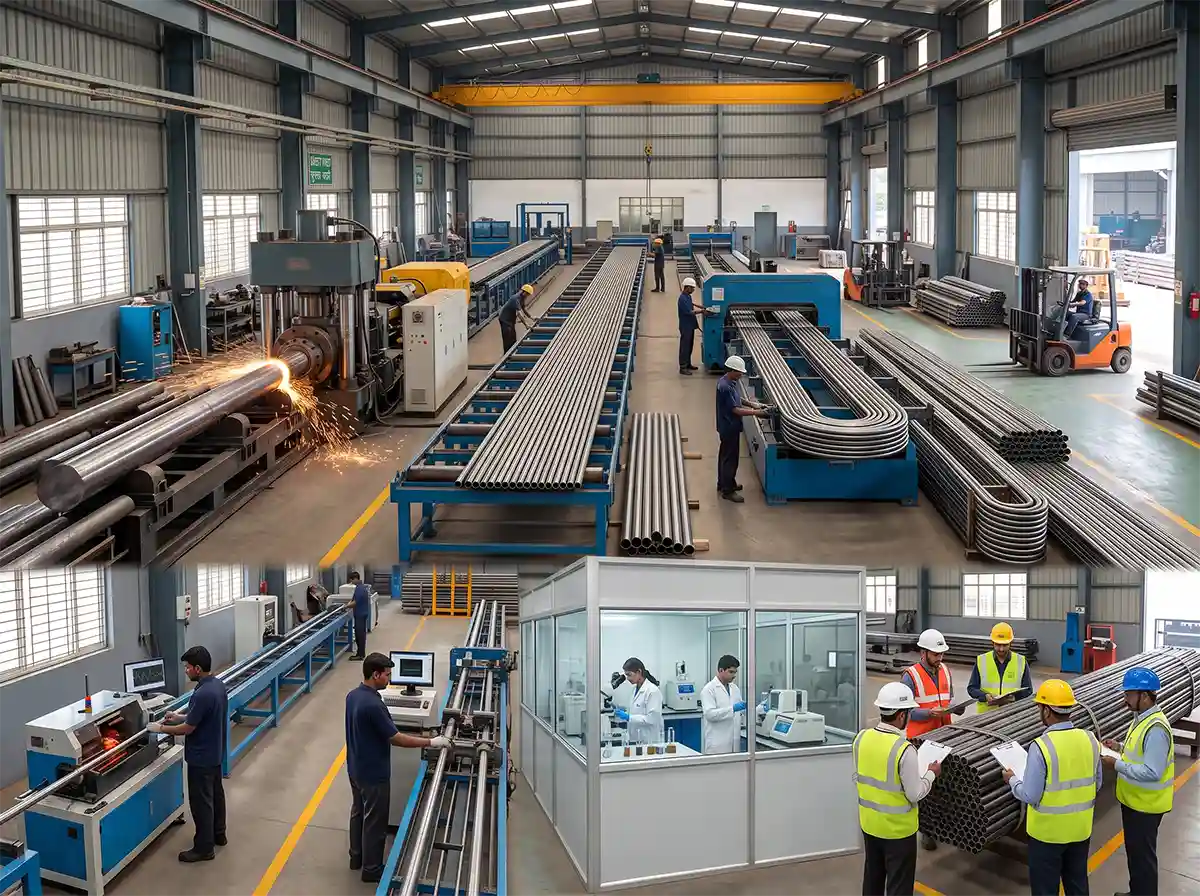
Why Choose Us as Your Heat Exchanger Tubes and U-tubes Supplier in India and Beyond?
- We make our own mother hollow starting from round bar, so we can track every tube’s history from the very start.
- We can make tubes up to 25 metres long, meaning fewer joints are needed in long bundles.
- We supply both U-bend and straight tubes, all from one supplier with one certificate.
- We have our own NABL-accredited lab on site; no need to send testing elsewhere, so results come back faster.
- We’re happy to have outside inspectors check our work.
OD 4.00 – 50.80 mm
RA < 0.4 µm available
WT 0.50 – 6.00 mm
ID & OD finish
- FAQ
Frequently Asked Questions About Heat Exchanger Tubes and U-tubes
What size of heat exchanger tube does ASR MET Tech supply?
ASR MET Tech, a heat exchanger tube manufacturer in India, supplies OD 9.53 MM to 50.88 mm with wall thickness 0.50 mm to 3.68 mm, in lengths up to 25 m, supplied straight or as U-bends.
Does ASR MET Tech manufacture their own U-tubes or only straight tubes?
The short answer is yes, if fact, we are one of the biggest heat exchanger tubes and pipes suppliers in India. We supply straight tubes and formed U-bends. We also provide Post-bend heat treatment and dye-penetrant inspection of the bend area.
Is every tube tested, or do you test on a sample basis?
We apply eddy current and automatic ultrasonic testing on 100% of tubes for our critical-service orders. Mechanical, chemical and metallurgical testing is per heat, in our own NABL-accredited laboratory.
Does ASR MET Tech supply tubes for condenser and feedwater heater duty?
The short answer is yes; condenser tubes are typically 304 or 316L in thinner walls with a tight OD tolerance for tube-sheet fitment and roller expansion; feedwater heater tubes are normally ordered to ASTM A688.
Does ASR MET Tech supply heat exchanger manufacturers, or only end users?
Mostly, we supply companies that manufacture heat exchangers and pressure vessels, along with the contractors who buy tubes on their behalf for big projects. We’re a tube mill; we only make tubes, not full exchangers. So we’re never in competition with our own customers. For OEMs who order regularly, we set up a fixed list of sizes and deliver them on an as-needed schedule.
- Contact Us
Get a Quote Today
Corporate Office
B-210, Mondeal Square, Opp. Honest Restaurant, Nr. Prahaladnagar Garden, S.G. Highway, Ahmedabad – 380015, Gujarat, India
Factory & Operations
Survey No. 48, Ahmedabad–Bagodara Highway 8A, Opp. Super Gas, Nr. Mongal Mata Mandir, Kalyangadh – 382240, Ahmedabad, Gujarat, India